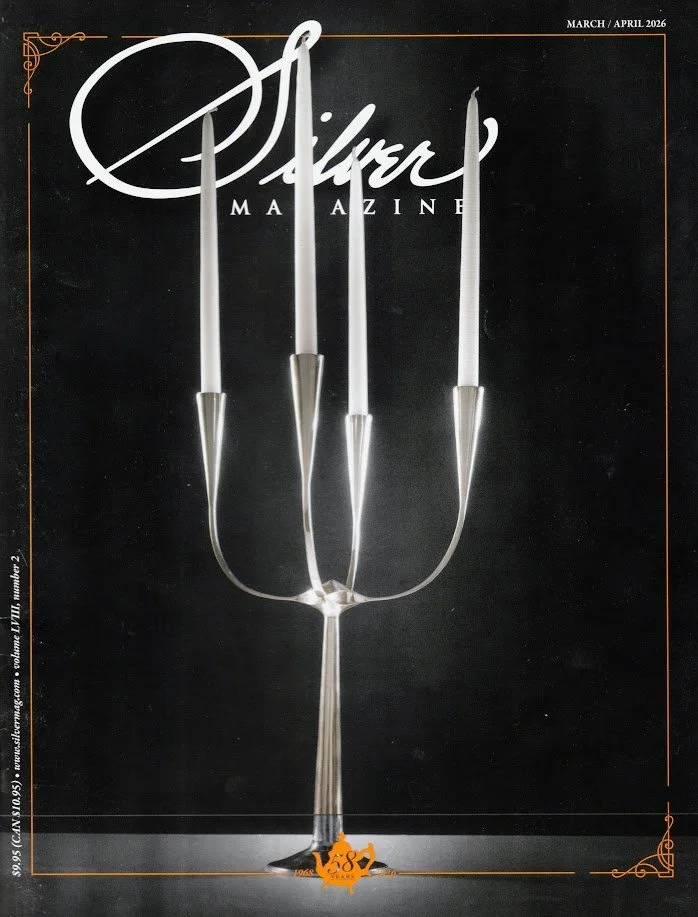
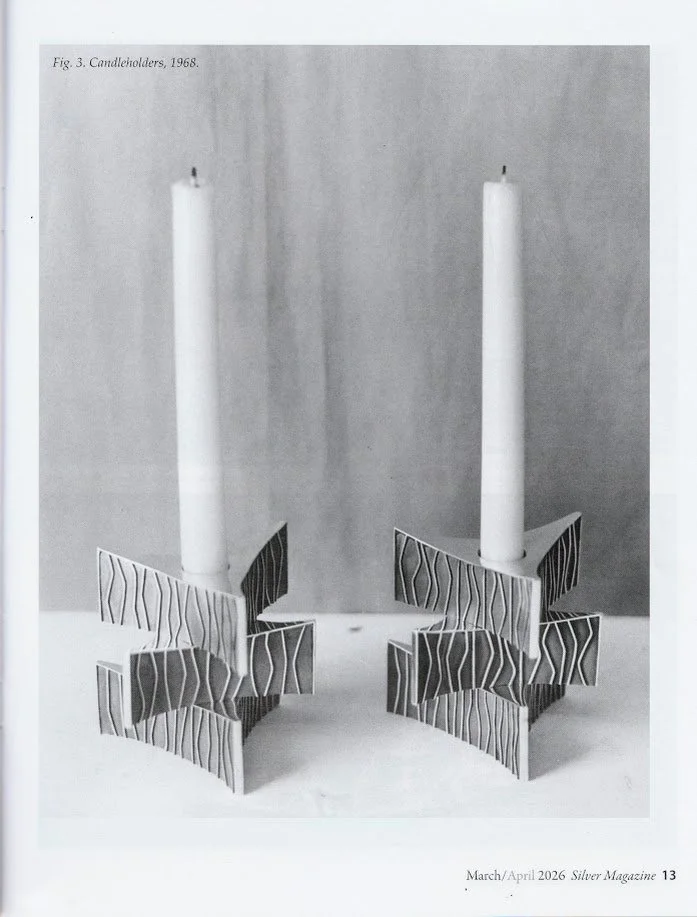
I am delighted to let you know that my article on mid-20th-century silversmith E. Dane Purdo (1926-2014) is the cover story in the just published issue of Silver Magazine. Silver Magazine is mining its archive and chose this article I wrote for them in 2009 for the cover of the April/May 2026 issue, which is graced by Purdo’s elegant attenuated candelabrum from 1960. This is my second Silver magazine cover story: in 2008 my article on Earl Krentzin was chosen for the cover of the magazine’s 40th anniversary issue. The article on Purdo has been republished as originally printed so it does not reflect the perspective of his passing but I have updated this summary to memorialize his very long and very creative and productive life both in the studio and out in the vibrant postwar crafts world, as an exhibitor and as a judge at the most prestigious museum-sponsored craft fairs and distinguished exhibition venues.
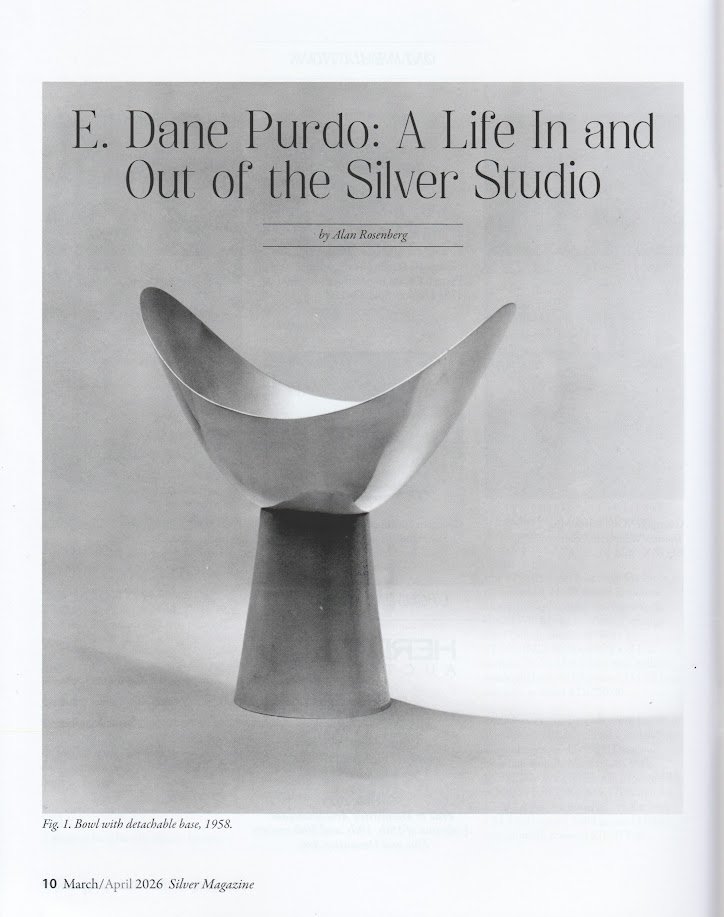
E. Dane Purdo’s work in sterling silver displayed the highest level of skill in both handcraftsmanship and design. His long career as a silversmith and teacher was highlighted by a distinguished list of exhibitions and a legacy of outstanding hollowware.
At the University of Michigan in Ann Arbor he majored in art history, graduating with a Master of Arts degree in l952. Purdo explained recently that “while at Ann Arbor I attended an evening class in jewelry making,” adding that “it was because of my keen interest in jewelry making that I entered Cranbrook Academy of Art in Bloomfield Hills, Michigan, and expanded my love of silver to silversmithing.” Purdo earned his Master of Fine Arts degree at Cranbrook in 1955.
In 1958, following two years of study at the Royal College of Art in London as a Fullbright Scholar, the results of that experience were exhibited at the Museum of Contemporary Crafts alongside the works of other “Fulbrighters,” including Arline Fisch and Earl Krentzin. Purdo’s pieces had already been exhibited in a one-man show at Milwaukee-Downer College in 1955, and would be shown in one-man exhibitions at Ohio State University, Columbus, in 1962, and at the Bergstrom-Mahler Museum in Neenah, Wisconsin, in 1974.
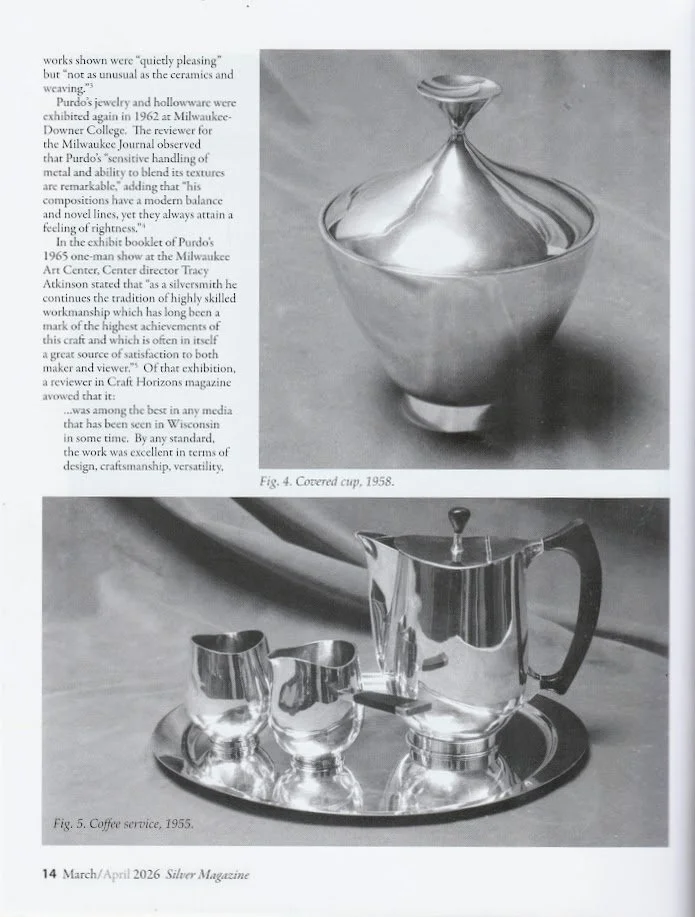
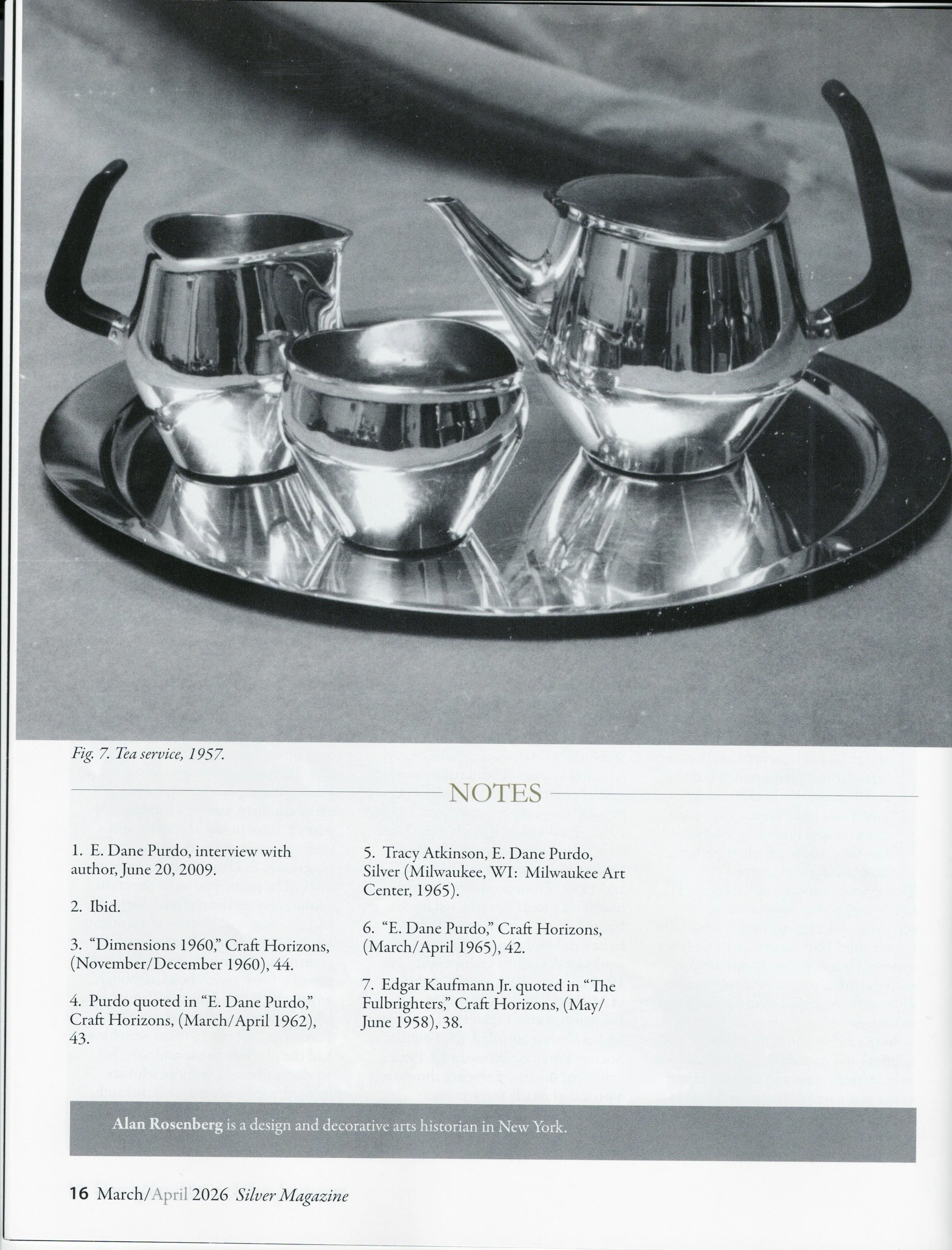
The sterling hollowware that Purdo created was characterized by carefully controlled contours, perfect balance between convex forms and concave outlines, and mirror-smooth surfaces.
In 1960, Purdo’s hollowware was exhibited in a three-person exhibition called Dimensions 1960, held at the New Mexico Highlands University Arrott Art Gallery in Las Vegas, New Mexico. The other two exhibitors were weaver Lenore Tawney and ceramist Peter Voulkos, both renowned today for their pivotal positions in twentieth-century crafts.
In conjunction with the 1958 Fulbright exhibition, Edgar Kaufmann, Jr. wrote that “in design, as in other fields, we are learning that America’s advantages, while great, are not guaranteed; we can maintain them best by a friendly participation in world activity and in the accompanying criticism and progress.”
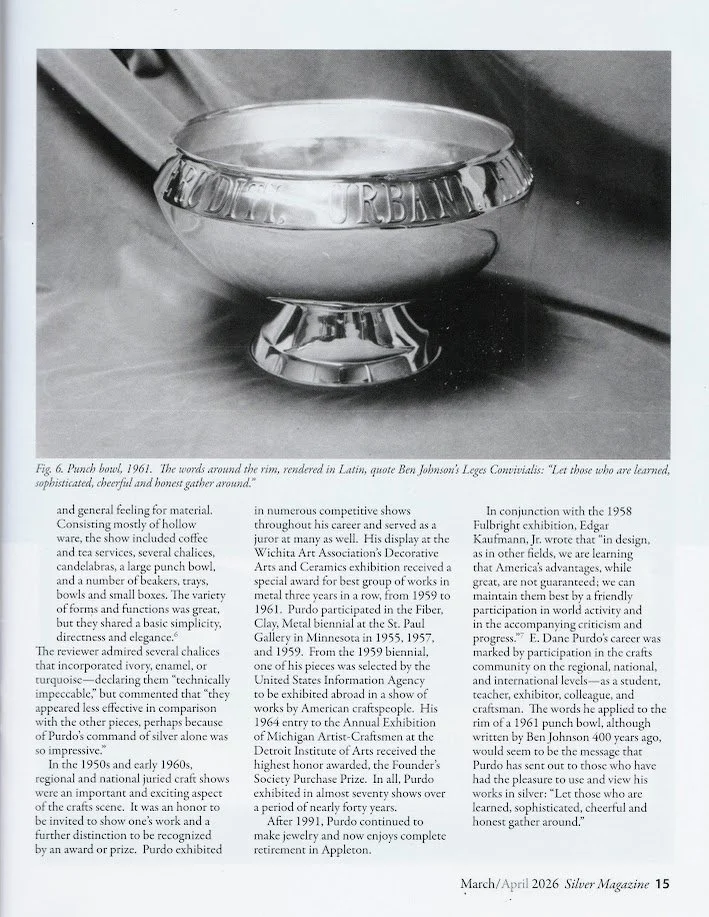
E. Dane Purdo’s career was marked by participation in the crafts community on the regional, national, and international levels—as a student, teacher, exhibitor, colleague, and craftsman. The words he applied to the rim of a 1961 punch bowl, although written by Ben Johnson 400 years ago, would seem to be the message that Purdo sent out to those who have had the pleasure to use and view his works in silver: “Let those who are learned, sophisticated, cheerful and honest gather around.”