
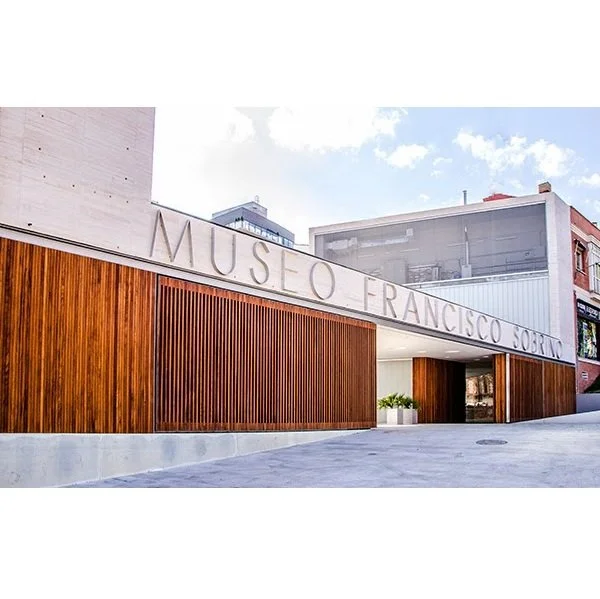







Layla D’Angelo: B Forever is a ten year retrospective of the artist’s kinetic sculpture at the Museo Francisco Sobrino in Guadalajara, Spain, June 19th to September 6th, accompanied by a catalogue by Alan Rosenberg, with texts in Spanish and English.
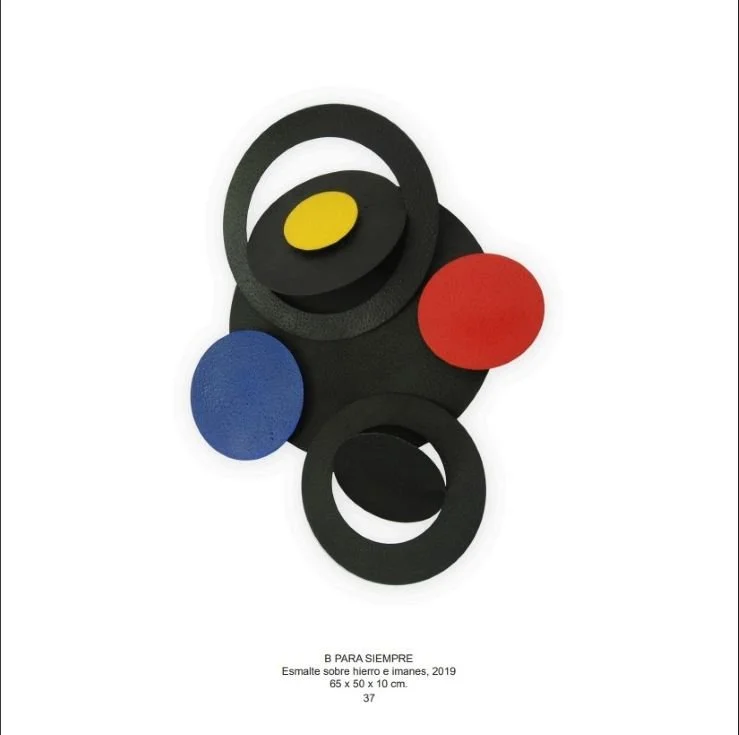
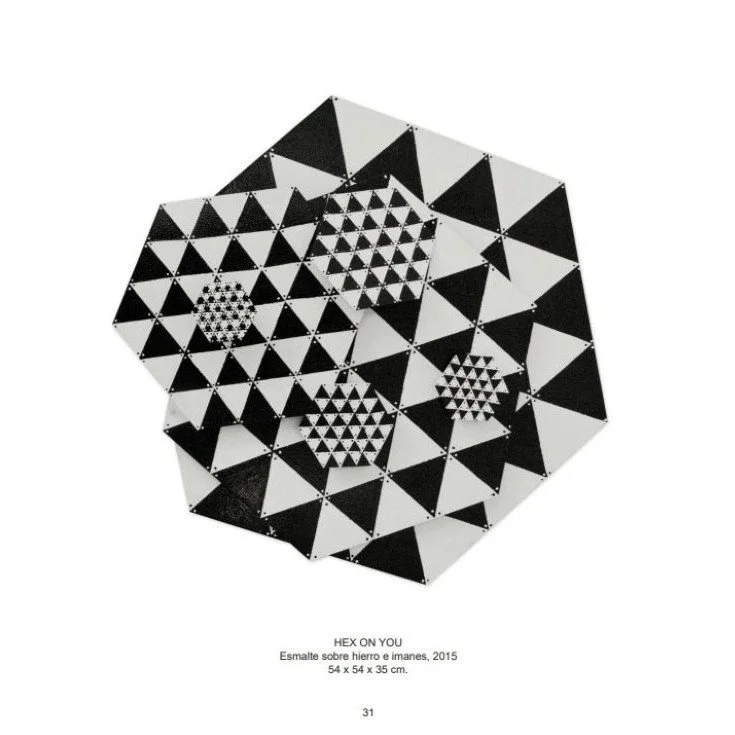
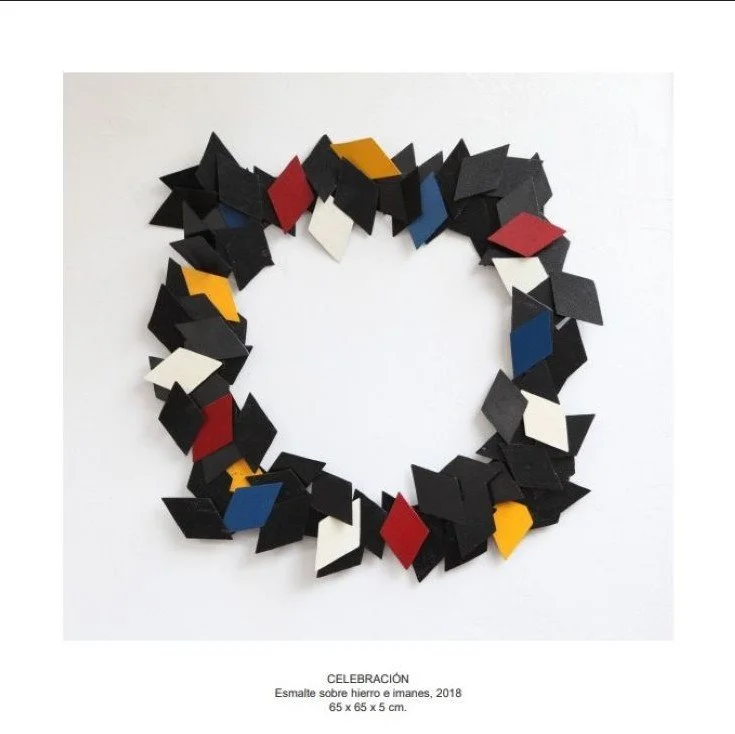
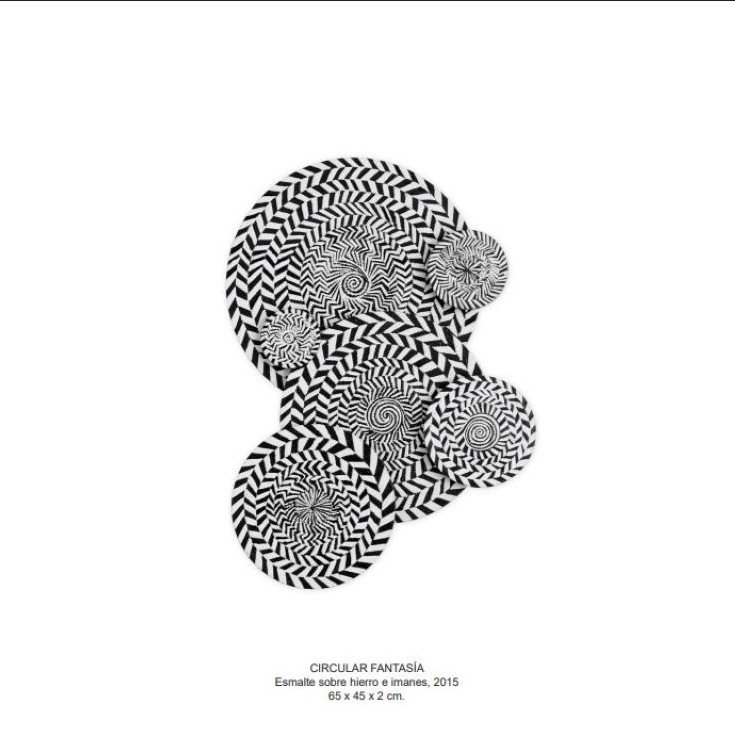
Layla D’Angelo’s art offers an invitation to the infinite. Hints of Russian constructivism, op art and kinetic sculpture are combined in black, white, yellow, red and blue wall mounted iron constructions, held together with magnets, that can be subjected to unlimited reconstruction by the viewer. Fragmentary flat iron pieces suggest diamonds, lozenges, fishscales or jigsaw puzzle pieces, the composite form of which is never final, never reaching conclusion. The black -and-white image of the chess or checkers board is present in works that are an invitation to play: move the game pieces and plot your next move.
A closer look at the surface of the artist’s earlier iron pieces, exhibited in 2016 in Barcelona at Galerie H2O in an exhibition poetically titled “Beautiful Strange Stranger,” reveals painstakingly applied minute dots of color which upon close inspection are discovered to be nail polish. The sculptures have the appearance of pure abstractions but the artist’s use of nail polish as paint give them a literal coating of post-feminist critique. Their resemblance to exploded patchwork quilts and use of a raw material of feminine allure suggest a subtle and simultaneous critique and celebration of women’s work and beauty culture. D’Angelo’s play on femininitude is seen in works that appear as concentric circles, evoking the mystique of the female physical void and the feminine psychic vortex. The constructions’ fragmentation and mutability stand in opposition to the classical monolith, associated art historically with the male presence.
In D’Angelo’s recent work she has altered her technique and her palette, reflecting her personal desire to explore new, but still unconventional ways to apply color, and in response to ecological concerns. The artist explains that “the dots, which are bigger, are applied with a syringe. The new pieces are less toxic as I use an ecological water based acrylic paint; totally different from the super-toxic nail polish.” The black and white of the earlier work, hinting at signs of hazard, has been gradually supplanted by the primary colors of red, yellow and blue, a simple experience of aesthetic pleasure and the added bonus of being non-toxic, for artist and audience.
D’Angelo’s corner mounted works echo the Russian constructivists’ engagement of this previously overlooked placement: Vladimir Tatlin’s 1914 “Corner Counter-Relief” and the 1915 Petrograd exhibition of Suprematist paintings by Kazimir Malevich, in which his black and white geometric canvases took on three-dimensional form through oblique mounting at the meeting of walls and ceiling. Echoes of mid-20th century Latin-American neo-constructivism are present as well: the astute observer will notice a nod to Lygia Clark’s relational objects and flexible sculptures of the 1950s and 60s. The artist credits an admiration for Mondrian in the emphasis on the red, yellow and blue in her recent work. Even the most uninformed art viewer will recognize D’Angelo’s quotation of ultimate Op artist Bridget Riley’s stripes and spirals. Historical antecedents are apparent, but D’Angelo is not a theorist or an academic. A life devoted to creativity, beauty and pleasure has brought her art to the place it occupies today. When asked the meaning of the seemingly cryptic title of the present exhibition “B Forever” she remarks that “B is for my darling late friend Bernardino. He loved this work.” Bernardino’s affirming presence was recognized in the second exhibition of the artists kinetic art, presented at Barcelona’s Espronceda Institute of Art & Culture, jauntily titled “Anyway Bernardino” and, indeed, the art moved in any way the viewers chose to recompose it, via D’Angelo’s unique use of magnets to make art that is mutable.
Despite the protestations by the artist that there is no “deep” meaning to her work, other than creating art that brings pleasure, her kinetic art is literally a visual puzzle, and it is part of a lineage in art history (a lineage magnificently represented by the Museo Francisco Sobrino itself).
Rosalind Krauss observed that in constructivist theory art was seen as "an investigatory tool in the service of knowledge." What knowledge is D’Angelo seeking to convey? Is there even any objective truth to convey? The title of one piece, “Chequered Life,” and its changeable form suggest that there is no objective truth but instead there is only subjective experience: life is open ended and art is what you make of it, literally. In this sense D’Angelo’s constructions are Dionysian rather than Apollonian. They are on the side of subjective play, chance and the irrational rather than objective truth and enlightenment. They are subjects not objects: they are constantly subject to the absolute control of the viewer.
©Alan Rosenberg